
Suitable workforce volumes at employer sites
Mobile delivery can reduce travel and disruption when the clinical and site requirements can be met.
MedicoWize can scope mobile and on-site occupational medical delivery for employers where workforce size, site conditions and the clinical requirements make workplace delivery practical. The aim is less operational disruption with the same risk-based assessment, confidentiality and central clinical governance.
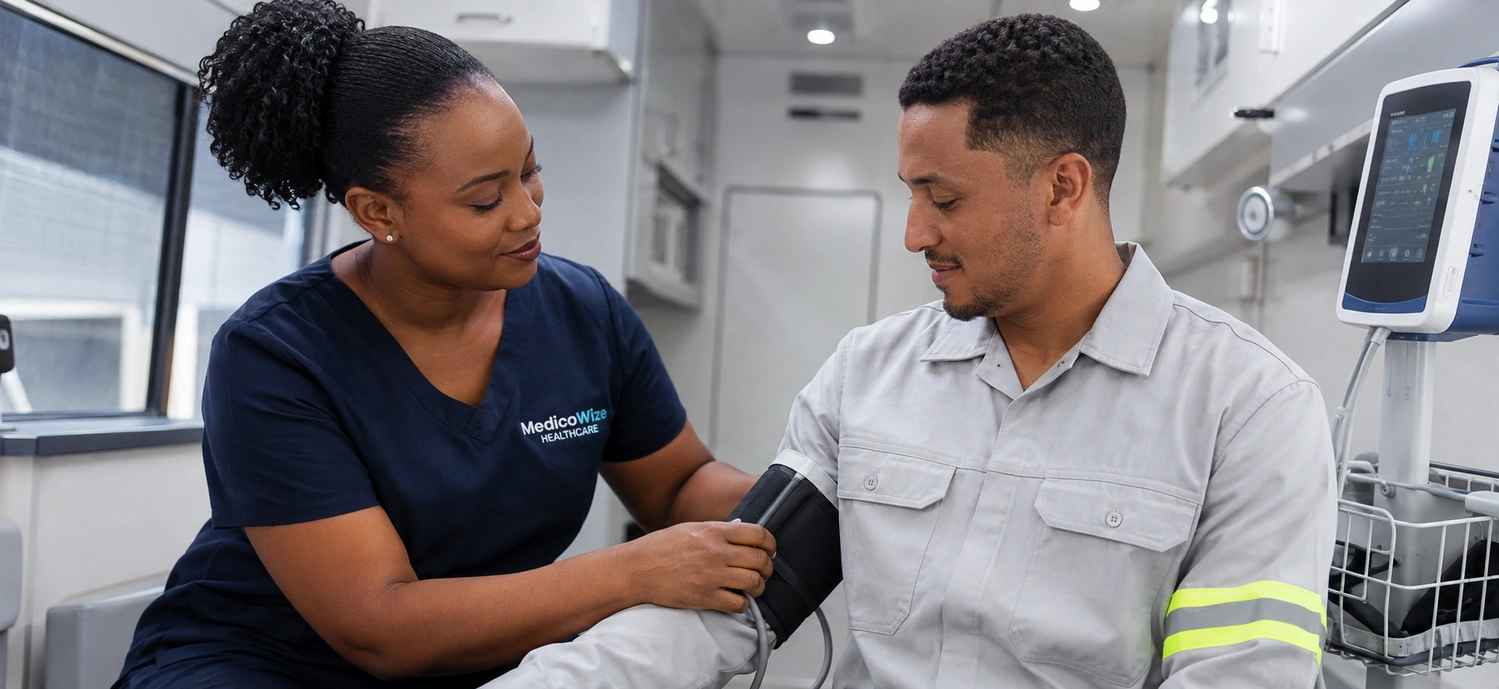
Employers often request mobile medicals or on-site occupational medicals because sending a large workforce away from site can disrupt production, project schedules and employee flow. The right mobile model is more than placing equipment in a room. It requires a defined assessment scope, suitable facilities, employee scheduling, privacy, safe clinical workflow, reliable records, exception handling and a clear route for investigations that cannot be completed on site. MedicoWize plans mobile delivery as part of the broader Occupational Health system.
Mobile delivery can reduce travel and disruption when the clinical and site requirements can be met.
A mobile clinic is an operating model, not a shortcut around clinical quality or exception handling.
Use the complete Occupational Health service to coordinate assessment groups, delivery, exceptions, reporting and follow-up.
On-site delivery works best when there is a clearly defined workforce, a repeatable assessment scope and a suitable environment for confidential clinical work. It may not be the best option for every employee or every investigation. Before scheduling, MedicoWize considers the number of employees, the job-risk groups, the services required, site access, privacy, power or equipment needs and the likely number of clinical exceptions.
The decision should balance convenience with quality. A smaller group with complex individual needs may be better served at the Midrand practice, while a large workforce requiring consistent baseline or periodic assessments may benefit significantly from a mobile model.

Workforce size and assessment volume
Clinical scope and equipment requirements
Suitable private space at the employer site
Employee flow and shift arrangements
Exception pathway for clinic-based or referred assessment
Mobile medicals become inefficient when employees arrive without the information needed to determine which assessment applies. The employer should prepare accurate employee details, job roles and relevant risk or exposure groups before the visit. That allows MedicoWize to plan the correct workflow and reduces time lost to changing assessment requirements on the day.
Where the employer has several departments or sites, the workforce can be segmented into sensible groups. The clinical scope still remains individual, but the operational process becomes more predictable.

Employee names and identifiers managed securely
Job title and essential role category
Relevant exposure or surveillance group
Assessment type or programme stage
Shift and availability information for scheduling
Convenience should never turn an occupational medical into a public production-line event. Employees need an appropriate setting for history taking, examination and any confidential discussion. Employer representatives can support logistics, but they should not have access to private clinical conversations or detailed medical findings simply because the service is delivered on their premises.
MedicoWize plans the on-site workflow so administrative movement and clinical privacy are separated as far as practical. The employer receives the agreed work-related outcomes through the normal reporting pathway rather than observing the clinical assessment itself.

Private space for confidential consultation
Controlled access to clinical areas
Appropriate handling of forms and records
Employer-facing fitness outcomes separated from clinical notes
Secure transfer of information back into central governance
A mobile service should not become a fixed package simply because equipment is available on site. The assessment and tests still need to relate to job demands, workplace exposure, programme requirements and clinical judgement. Depending on the workforce, mobile delivery can support occupational medicals, baseline or periodic surveillance and relevant screening, while some complex investigations remain better suited to a clinic or external referral.
This preserves the same principle used across MedicoWize Occupational Health: define the work-related question first and choose the assessment that answers it. Location is a delivery decision, not a reason to broaden testing unnecessarily.

Role-appropriate occupational medical assessment
Relevant screening or surveillance components
Fitness-for-work outcome where the scope supports it
Further investigation when on-site assessment is insufficient
No unnecessary test bundle applied to every employee
The commercial value of mobile delivery comes from reducing disruption, but poor scheduling can simply move the disruption onto site. Employee flow should reflect shift patterns, expected assessment duration, rest or preparation requirements where relevant and the capacity of the clinical team. Supervisors need a clear schedule without gaining access to confidential health information.
For larger projects, MedicoWize can help define booking intervals, daily volumes and escalation rules. A small buffer for clinical exceptions can prevent one complex case from delaying the entire workforce.

Realistic appointment intervals
Shift-aware employee sequencing
Separate admin and clinical stages
Buffer for exceptions or repeat testing
Daily reconciliation of completed and outstanding assessments
Employers with several sites need consistent outcomes, record standards and exception management. Mobile teams should not operate as isolated events. The assessment data, fitness outcomes, referrals and follow-up should connect back to one governed occupational-health process so an employee’s history is not fragmented across sites.
MedicoWize uses the Midrand base and broader clinical pathway to support central review. Employees who require further investigation can move into the appropriate clinic, specialist, return-to-work or incapacity pathway without the employer having to invent a second system.

Consistent assessment standards across sites
Central record and exception management
Defined referral and follow-up routes
Common employer reporting format
Programme review across repeated mobile visits
Bringing medicals to the workplace solves a delivery problem; it does not replace programme design. Employers may still need exposure-group planning, surveillance intervals, clinic-based exceptions, fitness review, occupational disease support, return-to-work decisions and central reporting across repeated visits or several sites.
Use the mobile pathway when the clinical scope and site conditions support it. Use the complete Occupational Health service when the organisation needs help defining which employees require which assessment, how findings will be escalated and how the programme will be governed over time.

Choose Mobile Occupational Medicals for suitable on-site workforce delivery
Use Occupational Medicals for the examination lifecycle
Use Medical Surveillance for ongoing exposure-related programmes
Use Pre-Employment Medicals for entry-stage assessment intent
Use Occupational Health for the complete employer system
Use the options below to compare examination, surveillance, pre-employment, workplace-delivery and screening needs before requesting a scope.
Risk- and role-aligned occupational medical examinations for South African employers, with clear fitness outcomes and confidential clinical handling.
Explore → Focused Occupational Health serviceRisk-based medical surveillance programmes for employers, including appropriate periodic assessment, testing, monitoring and fitness guidance.
Explore → Focused Occupational Health serviceRole-appropriate pre-employment, pre-placement and baseline medical assessments for employers requiring clear, defensible fitness outcomes. Clear, practical.
Explore → Focused Occupational Health serviceRisk-based occupational health screening for employers, including relevant hearing, lung-function and vision tests within a governed medical pathway.
Explore →If the need extends beyond this assessment or guide, review the complete Occupational Health service to coordinate workforce groups, clinical requirements, delivery and follow-up.
These links provide statutory, regulatory or professional context. They do not replace case-specific legal or medical advice.
Published by MedicoWize Healthcare for employer decision support and service scoping. Content is designed to explain pathways, preparation and work-related decision context; it does not replace an appropriately scoped medical assessment, legal advice or an employer’s own formal decision process.
Yes, where the workforce size, site environment, assessment scope and clinical requirements make on-site delivery appropriate. MedicoWize will first confirm what can reasonably be delivered at the site and what may still require clinic or referral support.
Typically the employer should provide an accurate employee list, job or risk-group information, suitable private space, practical site access and a scheduling plan. Exact requirements depend on the clinical scope and the workplace.
Yes, appropriate baseline or periodic surveillance components can be delivered on site when the programme, equipment and environment support them. Surveillance still needs to be risk-based and connected to central clinical governance.
Clinical consultation and records are kept separate from employer logistics. The employer receives the agreed work-related outcome, while detailed medical information remains handled through appropriate confidential processes.
The employee can be moved into an appropriate clinic-based, referral or follow-up pathway. The mobile visit should have a defined exception process rather than trying to complete every possible investigation at the workplace.
It is a focused delivery pathway within MedicoWize Occupational Health. The parent Occupational Health service remains the authority for the full workforce-health programme.
MedicoWize will route the enquiry to the appropriate occupational health, health risk, incapacity, medicolegal or wellness pathway and confirm the scope required.