
The work, hazard and target health effect
Select screening components only after the employer can explain the occupational-health purpose.
MedicoWize helps employers scope occupational-health screening such as audiometry, spirometry and vision testing where the role, exposure profile or programme makes those components relevant. Screening is connected to an appropriate occupational medical or surveillance pathway rather than sold as an isolated test bundle.
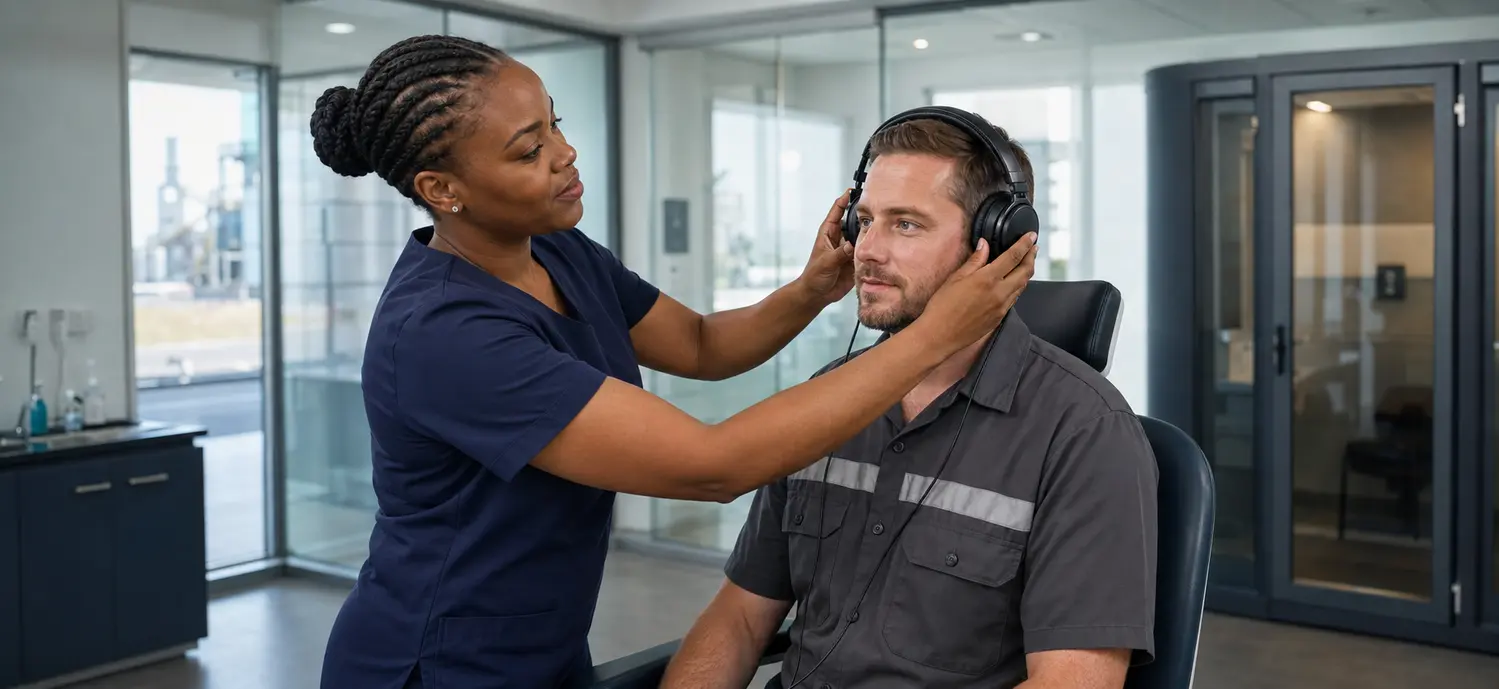
Employers may ask for industrial employee medical screening services when they need hearing, respiratory, vision or other health checks for a workforce. The clinically useful starting point is not a list of available machines. It is the job, hazard, exposure history, target health effect and decision required. MedicoWize uses that context to help define which screening components may be appropriate, how they fit into an occupational medical or surveillance programme, and what should happen when a result needs further review.
Select screening components only after the employer can explain the occupational-health purpose.
Screening results may need clinical interpretation, confirmation or further assessment.
Each programme has a different purpose, consent context, reporting boundary and next step.
Audiometry, spirometry or vision testing can produce important information, but a test result does not automatically establish whether an employee is fit for a role or whether a workplace exposure is adequately controlled. The result needs to be interpreted in context: why the test was performed, whether the method and conditions were suitable, what the employee’s work involves and whether further clinical assessment is required.
Employers should decide whether they need a once-off component within an occupational medical, repeated testing inside medical surveillance, or a broader fitness-for-work opinion. Naming that purpose before booking reduces unnecessary testing and gives the clinical team a clearer escalation route.

Define the job, hazard or exposure first
State whether the purpose is baseline, periodic review or another decision
Use the result with relevant clinical and work information
Provide a route for repeat testing or further assessment
Avoid treating one screening result as a complete fitness opinion
Different roles can require different health information. Noise exposure may make hearing surveillance relevant; respiratory exposure may support lung-function assessment; visual demands may justify an appropriate vision check. Other components should be added only where the work, applicable requirements and clinical purpose support them. A generic company-wide package can collect more information while answering fewer useful questions.
The employer can strengthen the scope by supplying job profiles, risk assessments, occupational-hygiene information, exposure groups and existing programme requirements. MedicoWize can then align the screening matrix with the employees who actually need each component rather than applying every test to every person.

Group employees by comparable work and exposure
Identify the target health effect for each test
Confirm any preparation or test-quality requirements
Keep the matrix proportionate to the risk
Review the matrix when work processes or exposures change
Occupational audiometry can help establish a baseline and identify meaningful hearing changes where employees are exposed to workplace noise or otherwise require hearing assessment. The value depends on suitable testing conditions, consistent methods, reliable records and a defined response when a result is abnormal or changes over time. A certificate alone does not explain whether the pattern is work-related or what intervention is appropriate.
Employers should know who reviews threshold changes, when repeat or diagnostic assessment is needed, how the employee will be informed and when the workplace exposure or controls require review. That connects hearing screening to prevention instead of leaving it as an isolated annual event.

Appropriate baseline for relevant employees
Consistent periodic testing where surveillance requires it
Review of significant or unexpected change
Clinical referral when screening cannot answer the concern
Employer action focused on work risk without exposing private detail
Spirometry measures aspects of lung function and may be relevant where the work involves respiratory hazards or a surveillance programme requires it. Results can be affected by technique, equipment quality, employee preparation and temporary health factors. A reliable process therefore includes appropriate test conduct, quality review and a route for clinical interpretation or further investigation when the result is not straightforward.
Employers should avoid using a single lung-function result as a stand-alone diagnosis or automatic employment decision. The occupational-health question, exposure history, symptoms, previous results and role requirements may all matter when deciding what happens next.

Link testing to a defined respiratory risk or purpose
Use suitable equipment and quality-controlled technique
Compare with prior results where longitudinal review is intended
Repeat or refer when test quality or findings require clarification
Keep the final work decision clinically and role informed
Visual requirements differ between office work, driving, machinery operation, fine-detail tasks and safety-sensitive environments. Screening should therefore be chosen for the actual functional demand rather than presented as one universal pass-or-fail standard. The same principle applies to any additional component: it must be relevant, proportionate and connected to a legitimate occupational-health purpose.
Where screening identifies a concern, the next step may be repeat testing, a more complete clinical assessment, optometry or another appropriate referral. The employer-facing outcome should concentrate on work implications and next actions rather than unnecessary private diagnostic information.

Describe the visual or functional demand accurately
Select an appropriate screening method
Avoid unrelated additions merely because equipment is available
Refer when screening is not sufficient for a conclusion
Express restrictions or review needs in practical work terms
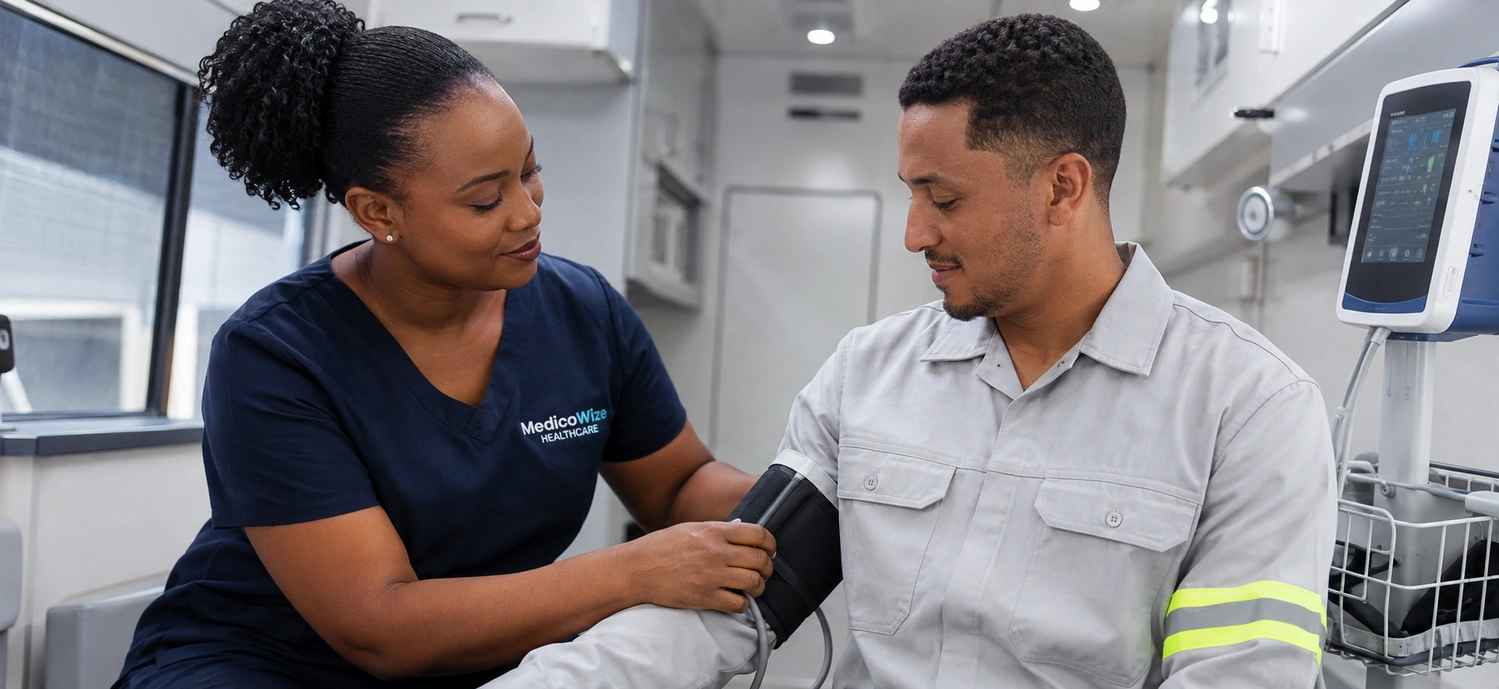
Industrial workforce screening may be delivered at the employer site when the numbers, facilities, equipment and clinical scope make that practical. The operating plan should cover private history-taking, employee scheduling, test preparation, record handling, infection-control or hygiene needs where applicable and a separate path for people who require more time or further assessment.
Supervisors can coordinate attendance without being given access to detailed results. MedicoWize can combine mobile screening with central clinical review so workplace convenience does not fragment the employee record or weaken exception management.
Suitable private and technically appropriate space
Shift-aware appointments and preparation instructions
Secure handling of clinical information
Separate logistics from clinical decisions
Defined clinic or referral pathway for exceptions
Occupational-health screening is selected because work, exposure or a role-specific decision makes the information relevant. General employee-wellness screening has a different purpose: it may help employees understand personal health risks, receive education or access referral, but it should not be presented as occupational surveillance or used to infer fitness for a job without an appropriate assessment.
If the employer needs hearing, lung-function, vision or other risk-linked testing, use the occupational-health pathway. If the purpose is a voluntary wellness day or broader preventive-health engagement, use the Employee Wellness Programme. Keeping the purposes separate protects employees and gives the organisation more useful reporting.

Occupational screening follows work risk and role requirements
Wellness screening supports voluntary personal-health awareness
Neither should be used outside its stated purpose
Employer reporting should match the programme and confidentiality rules
Choose the service before selecting the test list
Use the options below to compare examination, surveillance, pre-employment, workplace-delivery and screening needs before requesting a scope.
Risk- and role-aligned occupational medical examinations for South African employers, with clear fitness outcomes and confidential clinical handling.
Explore → Focused Occupational Health serviceRisk-based medical surveillance programmes for employers, including appropriate periodic assessment, testing, monitoring and fitness guidance.
Explore → Focused Occupational Health serviceRole-appropriate pre-employment, pre-placement and baseline medical assessments for employers requiring clear, defensible fitness outcomes. Clear, practical.
Explore → Focused Occupational Health serviceOn-site occupational medicals and workplace testing delivered around shifts, sites and workforce needs with minimal operational disruption. Clear, practical.
Explore →If the need extends beyond this assessment or guide, review the complete Occupational Health service to coordinate workforce groups, clinical requirements, delivery and follow-up.
These links provide statutory, regulatory or professional context. They do not replace case-specific legal or medical advice.
Published by MedicoWize Healthcare for employer decision support and service scoping. Content is designed to explain pathways, preparation and work-related decision context; it does not replace an appropriately scoped medical assessment, legal advice or an employer’s own formal decision process.
The correct components depend on the job, workplace hazards, exposure profile, programme requirements and the decision being supported. Audiometry, spirometry, vision or other tests should be selected only where they are relevant to that context.
Not necessarily. Screening can be one component of an occupational medical or surveillance programme. A complete occupational medical may also require relevant history, examination, clinical interpretation and a role-specific fitness outcome.
Yes, where the workforce size, site facilities, equipment needs and clinical scope support mobile delivery. The plan should include privacy, scheduling, quality control and a clinic or referral route for exceptions.
No. A screening result may require confirmation, clinical review or further investigation. Fitness-for-work depends on the complete evidence, the actual job demands and the relevant risks rather than one isolated value.
Provide the job groups, essential duties, hazards or exposure information, relevant risk-assessment findings, workforce numbers, site conditions and the decision or programme stage the screening must support.
Occupational screening is linked to work risk, exposure or a role-specific decision. Wellness screening supports broader personal-health awareness and referral. The tests, consent, reporting and employer use of results should reflect that different purpose.
MedicoWize will route the enquiry to the appropriate occupational health, health risk, incapacity, medicolegal or wellness pathway and confirm the scope required.