
Placement into a relevant role
The assessment should reflect the actual job demands, exposure and safety implications of the position.
MedicoWize provides role-appropriate pre-employment and baseline occupational medicals for employers who need a clinically grounded fitness decision before placement or entry into relevant work. The assessment is shaped by job demands and workplace risk rather than a generic recruitment checklist.

Pre-employment medicals may also be described as employment medical examinations, medical exams for work or baseline medicals. Those terms point to the same practical employer need: a defensible assessment before a person starts or is placed into a role where health, functional ability, exposure or safety can matter. MedicoWize structures the assessment around the job and the decision required, while protecting the applicant or employee from unnecessary disclosure and avoiding the assumption that every position needs the same medical tests.
The assessment should reflect the actual job demands, exposure and safety implications of the position.
A pre-employment medical should answer a legitimate work-health question and remain proportionate to the role.
Use Occupational Health for surveillance, role changes, ongoing fitness questions and the wider employee medical lifecycle.
A medical should not be added to recruitment simply because it appears on a standard onboarding checklist. The employer should be able to explain the work-related reason for assessment: the role may involve specific physical demands, safety-sensitive activity, occupational exposure or a surveillance requirement. That context helps keep the examination relevant and proportionate.
Where the role does not create a meaningful occupational-health question, the employer should avoid collecting health information without a clear purpose. Where a medical is appropriate, the referral should state the role, its essential duties and the decision MedicoWize is being asked to support.

Reason for the occupational-health referral
Essential duties and physical or cognitive demands
Relevant workplace exposure or safety risks
Any applicable industry or site requirements
The fitness decision needed before placement
For employees entering work where ongoing surveillance is appropriate, the initial assessment can establish relevant health information before or around exposure. That baseline becomes more valuable when future periodic assessments are designed consistently and interpreted against the same workplace risk. It should not become an excuse to collect unrelated medical data.
MedicoWize can align the entry medical with the employer’s surveillance programme so the first assessment is not disconnected from what happens later. This is especially useful where the employee will join a defined exposure or safety-sensitive group.

Relevant initial clinical and occupational history
Risk-linked screening where indicated
Documented starting point for future surveillance
Fitness outcome for the role assessed
Clear next-review pathway where the programme requires it
A clinician cannot assess fitness for work well if the referral says only “pre-employment medical”. The job profile should identify the tasks that matter, the environment in which they are performed and any safety implications. A role involving driving, climbing, heavy manual work, machinery, hazardous exposure or emergency response creates different questions from a purely office-based role.
The employer does not need to write a medical opinion. It needs to describe the work accurately. MedicoWize can then determine the relevant clinical assessment and express the outcome in terms the organisation can use.

Job title and essential duties
Physical demands and work environment
Safety-critical responsibilities
Known hazards or exposure profile
Required shift, travel or site conditions where relevant
Pre-employment packages can include long lists of tests, but the medically useful scope depends on the work. Audiometry, spirometry, vision or other assessments may be relevant for some roles and unnecessary for others. A risk-based approach reduces waste, supports fairness and keeps the examination connected to the actual employment decision.
MedicoWize uses the role and occupational-health context to decide what information is needed. Where additional assessment or specialist input is required before a safe conclusion can be reached, that should be managed as a clinical exception rather than hidden behind a one-size-fits-all package.

Relevant history and physical assessment
Role- or exposure-linked testing where indicated
Further investigation only when clinically justified
Avoid unrelated screening that does not support the work decision
Document the basis for the fitness conclusion
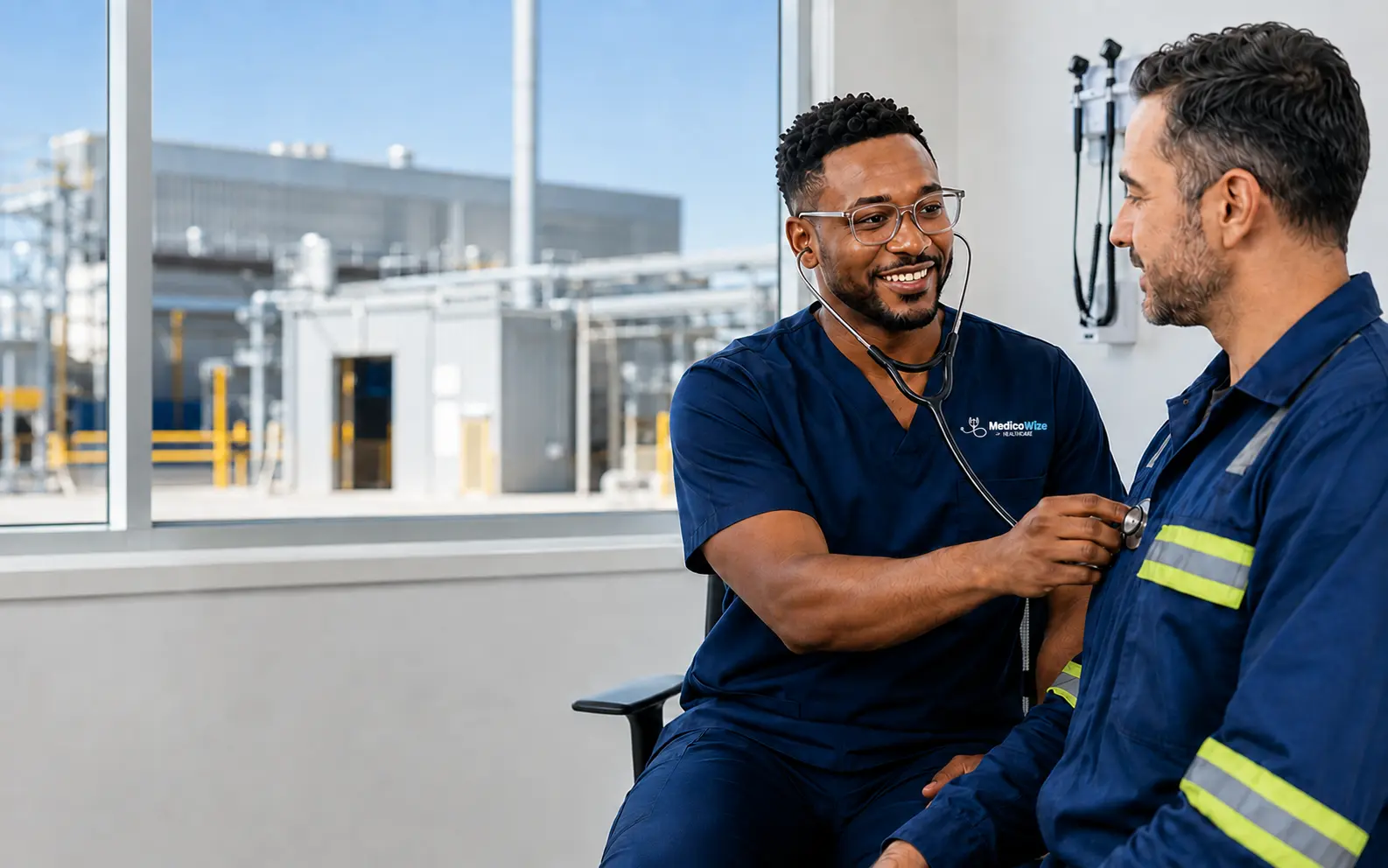
A pre-employment medical can involve sensitive personal information. The employer’s operational need is normally a work-related conclusion such as fit, fit with appropriate restrictions, further review required or another clinically suitable outcome. The detailed medical record should not become a recruitment document circulated through the organisation.
MedicoWize separates the clinical assessment from the employer-facing result so HR and operational teams can make the required placement decision without unnecessary access to private health information.
Work-related fitness outcome
Practical restrictions or review requirements where relevant
Confidential management of detailed clinical records
Consistent communication to authorised employer stakeholders
Clear next step when the assessment cannot yet be concluded
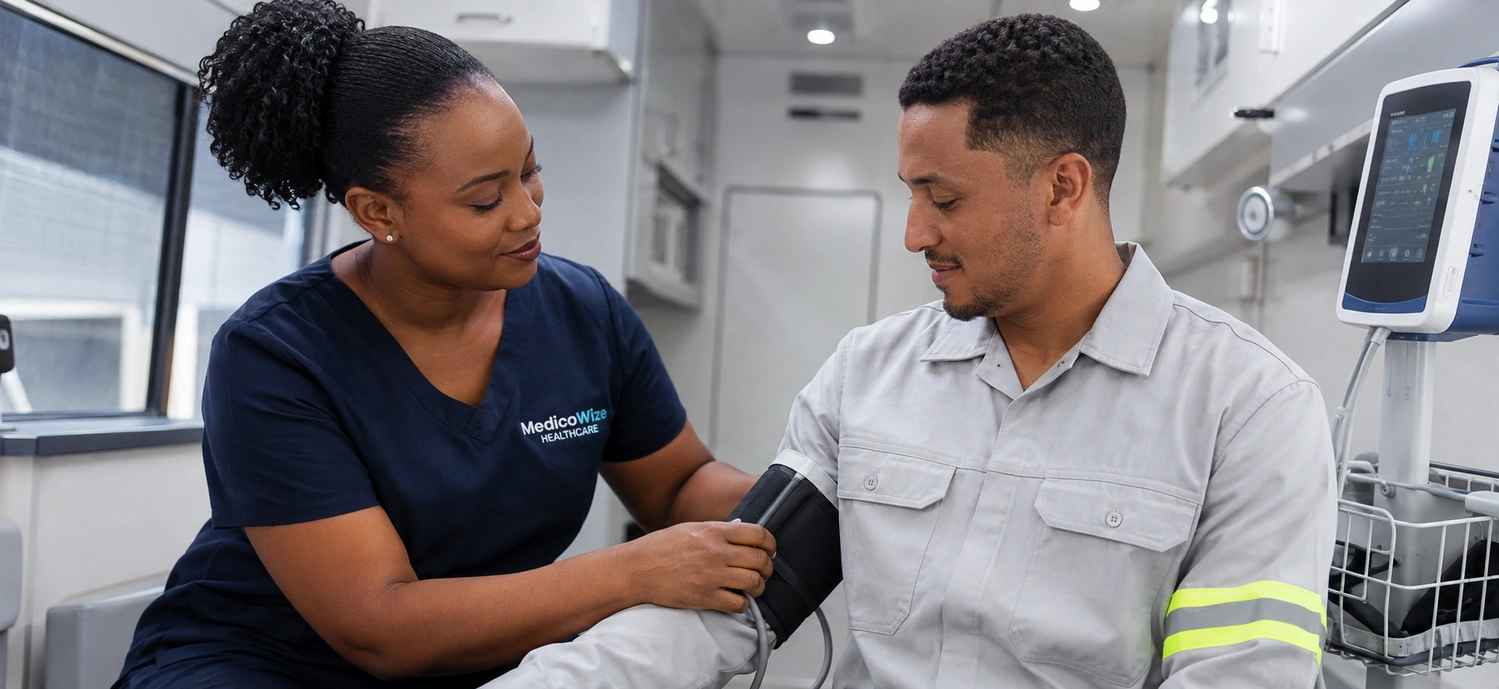
Construction projects, logistics operations, manufacturing sites and expanding employers may need many employees assessed within a short period. The risk is that scheduling pressure overwhelms the clinical process. A defined workflow can collect job information before appointments, group employees by assessment requirement, plan on-site or clinic delivery and create an exception route for employees who need further review.
MedicoWize can help scope the operational pathway so routine cases move efficiently without lowering the quality of decisions. Mobile delivery may be appropriate for larger groups, while complex cases can remain under central clinical governance.
Role-based employee lists before scheduling
Assessment matrix by job or risk group
Batch scheduling with protected clinical privacy
On-site delivery where the scope is suitable
Separate exception and referral pathway
A pre-employment medical supports a decision before placement, but workforce health continues after onboarding. Where the role involves ongoing exposure or defined occupational risk, the employer may also need periodic surveillance, role-change review, return-to-work support and an exit assessment at the appropriate stage.
Use the baseline consistently in later assessments, keep the job and exposure information current and define when an individual finding should move into a different clinical or incapacity pathway. This gives the employer a lifecycle process rather than a once-off onboarding document.

Choose Pre-Employment Medicals for entry, placement and baseline decisions
Use Occupational Medicals for the wider examination lifecycle
Use Medical Surveillance for ongoing exposure-related monitoring
Use Mobile Occupational Medicals when delivery must happen at the workplace
Use Occupational Health for the full employer programme
Use the options below to compare examination, surveillance, pre-employment, workplace-delivery and screening needs before requesting a scope.
Risk- and role-aligned occupational medical examinations for South African employers, with clear fitness outcomes and confidential clinical handling.
Explore → Focused Occupational Health serviceRisk-based medical surveillance programmes for employers, including appropriate periodic assessment, testing, monitoring and fitness guidance.
Explore → Focused Occupational Health serviceOn-site occupational medicals and workplace testing delivered around shifts, sites and workforce needs with minimal operational disruption. Clear, practical.
Explore → Focused Occupational Health serviceRisk-based occupational health screening for employers, including relevant hearing, lung-function and vision tests within a governed medical pathway.
Explore →If the need extends beyond this assessment or guide, review the complete Occupational Health service to coordinate workforce groups, clinical requirements, delivery and follow-up.
These links provide statutory, regulatory or professional context. They do not replace case-specific legal or medical advice.
Published by MedicoWize Healthcare for employer decision support and service scoping. Content is designed to explain pathways, preparation and work-related decision context; it does not replace an appropriately scoped medical assessment, legal advice or an employer’s own formal decision process.
No. The need and scope should be based on the role, workplace risk, relevant exposure, applicable requirements and the employer’s occupational-health programme. MedicoWize does not assume that every office or job requires the same medical.
Provide the job title, essential duties, relevant physical or cognitive demands, known hazards or exposures, safety-sensitive requirements and the exact fitness decision needed. Better job information generally produces a more useful assessment.
There is no single universal list. Relevant history, examination and any supporting tests should be selected according to the role, risk and clinical purpose. Some jobs may require specific screening while others may not.
Yes, where the number of employees, site conditions and assessment scope support mobile delivery. The programme should still include a route for employees who need additional clinic-based assessment or referral.
The employer receives an appropriate work-related fitness outcome and any relevant restrictions, review requirements or next steps. Detailed private clinical information is handled separately through professional confidentiality processes.
If the role is part of an occupational-health surveillance programme, the baseline can feed into future periodic monitoring. Broader workforce-health needs should be managed through MedicoWize’s Occupational Health service.
MedicoWize will route the enquiry to the appropriate occupational health, health risk, incapacity, medicolegal or wellness pathway and confirm the scope required.