
Risk, exposure and job information
Accurate workplace context helps the medical pathway answer the right occupational-health question.
SHEQ teams often coordinate workplace risk information, employee groups, medical schedules and corrective actions. MedicoWize supports the occupational-health part of that system through appropriately scoped medicals, surveillance, screening, fitness input and clinical referral while leaving safety, environmental and quality disciplines with the responsible specialists.

SHEQ commonly brings Safety, Health, Environment and Quality responsibilities together, but those disciplines are not interchangeable. MedicoWize’s role is the occupational-health and medical pathway: understanding the work-related health question, using relevant exposure and job information, conducting or coordinating appropriate assessments, protecting clinical confidentiality and reporting practical work-related outcomes. A SHEQ team can improve the quality of that process by providing accurate risk information and coordinating employer action without taking over clinical decisions.
Accurate workplace context helps the medical pathway answer the right occupational-health question.
Medical decisions, confidential records and clinical referrals remain under appropriate professional governance.
Safety, environment, quality, certification and training remain with the relevant competent specialists.
SHEQ teams may identify a need through risk assessment, exposure monitoring, incident review, audit findings, employee concerns or a change in work. The next step is to translate that signal into a clear occupational-health question. Does a defined group need baseline or periodic surveillance? Does an employee need a role-specific fitness review? Is a screening component appropriate, or is the concern really about workplace control rather than medical testing?
A concise question helps MedicoWize choose the appropriate clinical pathway and helps the employer avoid using medicals as a substitute for safety or exposure control. The workplace remains responsible for managing hazards; the occupational-health process contributes relevant health evidence and recommendations within professional scope.

State the hazard, exposure or job demand
Identify the employee group or individual concerned
Explain the decision the employer must make
Separate medical input from safety and engineering controls
Agree who will act on the work-related outcome
SHEQ teams often hold information that materially improves an occupational-health assessment: risk registers, job categories, workplace hazards, control measures, occupational-hygiene findings, incident patterns and changes to processes or equipment. The clinical team does not need every operational document for every referral, but it does need the information that explains why the assessment is being requested and what health effect or work demand matters.
The employer should provide relevant summaries through an authorised pathway and avoid sending unrelated confidential material. MedicoWize can help identify the minimum useful inputs for a workforce programme or individual referral so the assessment remains focused and proportionate.

Job title, essential duties and safety-sensitive tasks
Relevant hazards, exposure groups and control measures
Reason for referral or programme stage
Applicable prior outcomes or restrictions where lawfully available
The specific employer decision requiring support
A SHEQ team can help prevent one-size-fits-all medicals by grouping employees according to comparable work and exposure. The matrix can distinguish entry or baseline assessment, periodic surveillance, role-change review, exit assessment and individual fitness referrals. It should also identify which components apply to each group and which situations require clinical review rather than automatic scheduling.
MedicoWize can use this operating information to scope occupational medicals without turning SHEQ staff into medical decision-makers. Clinical relevance, examination content and fitness conclusions remain under appropriate health-professional governance.

Map roles to relevant risk and exposure groups
Define lifecycle assessment points
Separate routine scheduling from clinical exceptions
Keep assessment requirements current when work changes
Use consistent employer-facing outcome language
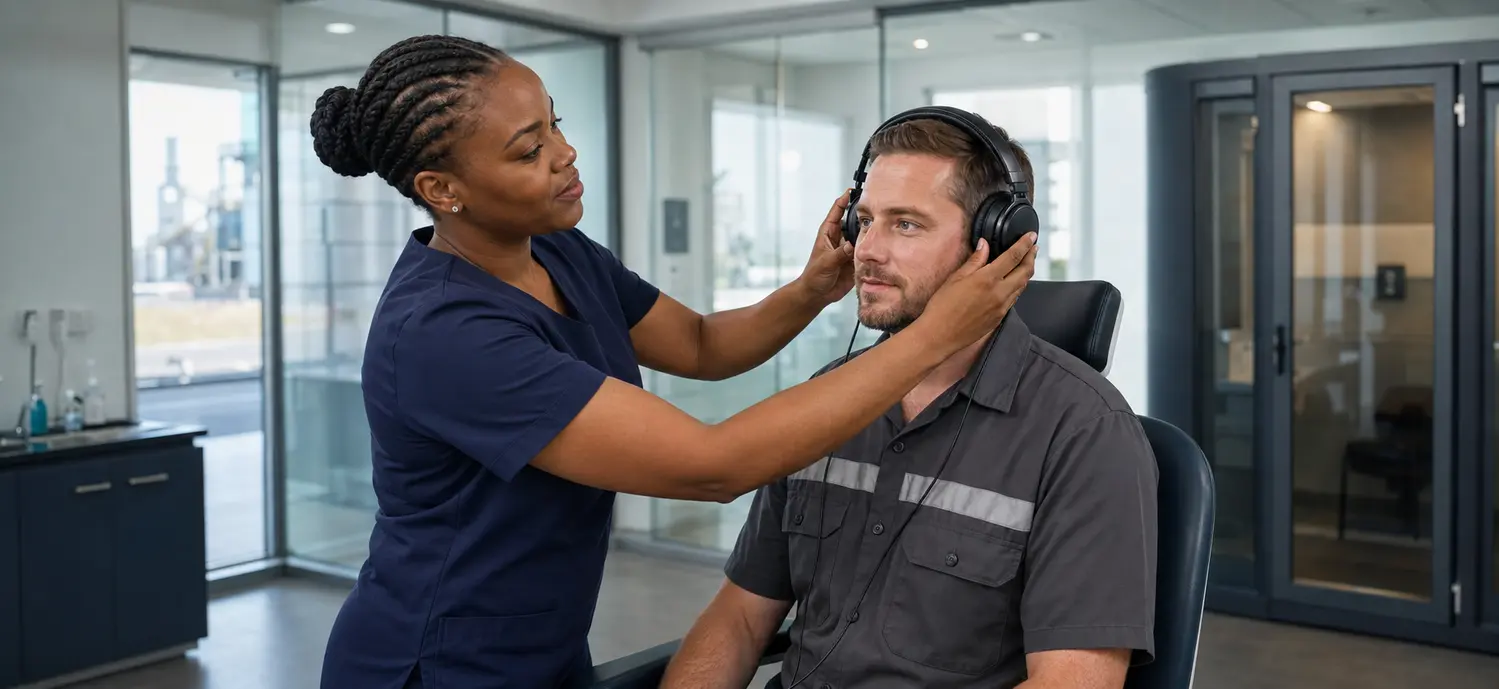
Medical surveillance follows a defined workplace hazard or occupational risk over time. Screening components such as audiometry, spirometry or vision testing may support that programme where they are relevant, but the equipment list should not drive the scope. SHEQ teams can contribute exposure information, affected employee groups and operational changes; MedicoWize can support the medical programme, clinical interpretation and escalation pathway.
Programme-level trends may prompt a review of workplace controls, but identifiable medical information remains protected. The SHEQ team should receive the agreed work-related and programme information needed for action, not unrestricted access to individual clinical records.
Link the programme to a defined hazard or exposure
Use suitable baseline and periodic assessment stages
Review meaningful individual and programme-level change
Protect employee confidentiality in employer reporting
Escalate concerning findings and workplace patterns
Not every occupational-health result fits a routine certificate workflow. An employee may need repeat testing, further medical investigation, a role-specific fitness review, temporary restrictions or a different pathway after illness or injury. The SHEQ team can support timely operational action and risk control, while HR, management and clinical stakeholders handle their separate responsibilities.
Where the issue becomes sustained work capacity, accommodation, repeated absence or possible ill-health retirement, the employer may need Employee Incapacity Management or Health Risk Management rather than repeated routine medicals. A clear escalation rule prevents cases from circulating without ownership.

Name the person or role responsible for receiving exceptions
Separate urgent clinical follow-up from routine programme review
Translate restrictions into practical work controls
Set review dates for temporary outcomes
Move complex capacity matters into the correct pathway
SHEQ staff may need to know whether a person can safely perform a task, whether restrictions affect exposure or equipment use, whether a review date applies and whether a workforce pattern requires risk-control attention. They do not automatically need the employee’s diagnosis, treatment history or complete clinical record. The reporting agreement should state what information is shared, with whom and for what operational purpose.
MedicoWize separates clinical detail from employer-facing outcomes. The SHEQ team can then coordinate workplace action without becoming the custodian of unnecessary personal medical information or interpreting raw test results outside its role.

Share fitness status and relevant work restrictions
State review timing and required operational action
Keep detailed clinical notes in the medical pathway
Limit employer access to authorised stakeholders
Use aggregated programme information where appropriate
MedicoWize can support SHEQ teams with occupational medicals, medical surveillance, relevant screening, fitness-for-work input, clinical referrals and workplace-health programme scoping. This does not mean MedicoWize provides the organisation’s complete SHEQ function. Occupational-safety systems, environmental management, quality management, ISO certification, legal compliance audits and SHEQ training require the appropriately qualified and appointed specialists.
A clear boundary improves collaboration. The SHEQ team manages the wider organisational system and workplace controls; MedicoWize provides occupational-health and medical input within the agreed scope. Where another discipline is required, the organisation should appoint the relevant competent provider rather than expecting a medical assessment to replace that work.
Occupational medical and surveillance support
Clinical fitness and referral pathways
Confidential work-related reporting
No claim of full SHEQ consultancy or certification
Use the appropriate specialist for each non-medical discipline
Use the options below to compare examination, surveillance, pre-employment, workplace-delivery and screening needs before requesting a scope.
Risk- and role-aligned occupational medical examinations for South African employers, with clear fitness outcomes and confidential clinical handling.
Explore → Focused Occupational Health serviceRisk-based medical surveillance programmes for employers, including appropriate periodic assessment, testing, monitoring and fitness guidance.
Explore → Focused Occupational Health serviceRole-appropriate pre-employment, pre-placement and baseline medical assessments for employers requiring clear, defensible fitness outcomes. Clear, practical.
Explore → Focused Occupational Health serviceOn-site occupational medicals and workplace testing delivered around shifts, sites and workforce needs with minimal operational disruption. Clear, practical.
Explore → Focused Occupational Health serviceRisk-based occupational health screening for employers, including relevant hearing, lung-function and vision tests within a governed medical pathway.
Explore →If the need extends beyond this assessment or guide, review the complete Occupational Health service to coordinate workforce groups, clinical requirements, delivery and follow-up.
These links provide statutory, regulatory or professional context. They do not replace case-specific legal or medical advice.
Published by MedicoWize Healthcare for employer decision support and service scoping. Content is designed to explain pathways, preparation and work-related decision context; it does not replace an appropriately scoped medical assessment, legal advice or an employer’s own formal decision process.
MedicoWize can support appropriately scoped occupational medicals, surveillance, screening, fitness-for-work input, clinical referrals, confidential employer outcomes and programme planning within its occupational-health scope.
No. MedicoWize’s role is occupational health and medical support. Safety systems, environmental management, quality management, ISO certification, compliance audits and SHEQ training should be handled by the relevant competent specialists.
Provide accurate job groups, essential duties, hazards or exposure information, relevant risk-assessment findings, workforce numbers, programme stage and the decision the employer needs the assessment to support.
SHEQ should receive only the work-related information it is authorised and needs to act on, such as fitness status, practical restrictions or review requirements. Detailed clinical information remains protected through the appropriate medical and consent processes.
Escalation may be appropriate when findings require clinical investigation, a role-specific fitness decision, temporary restrictions, workplace-control review, return-to-work planning or a structured incapacity pathway.
No. Screening can provide relevant health information, but it does not replace identifying hazards, assessing workplace risk, implementing controls or reviewing exposure. The medical and workplace-control processes should support each other.
MedicoWize will route the enquiry to the appropriate occupational health, health risk, incapacity, medicolegal or wellness pathway and confirm the scope required.